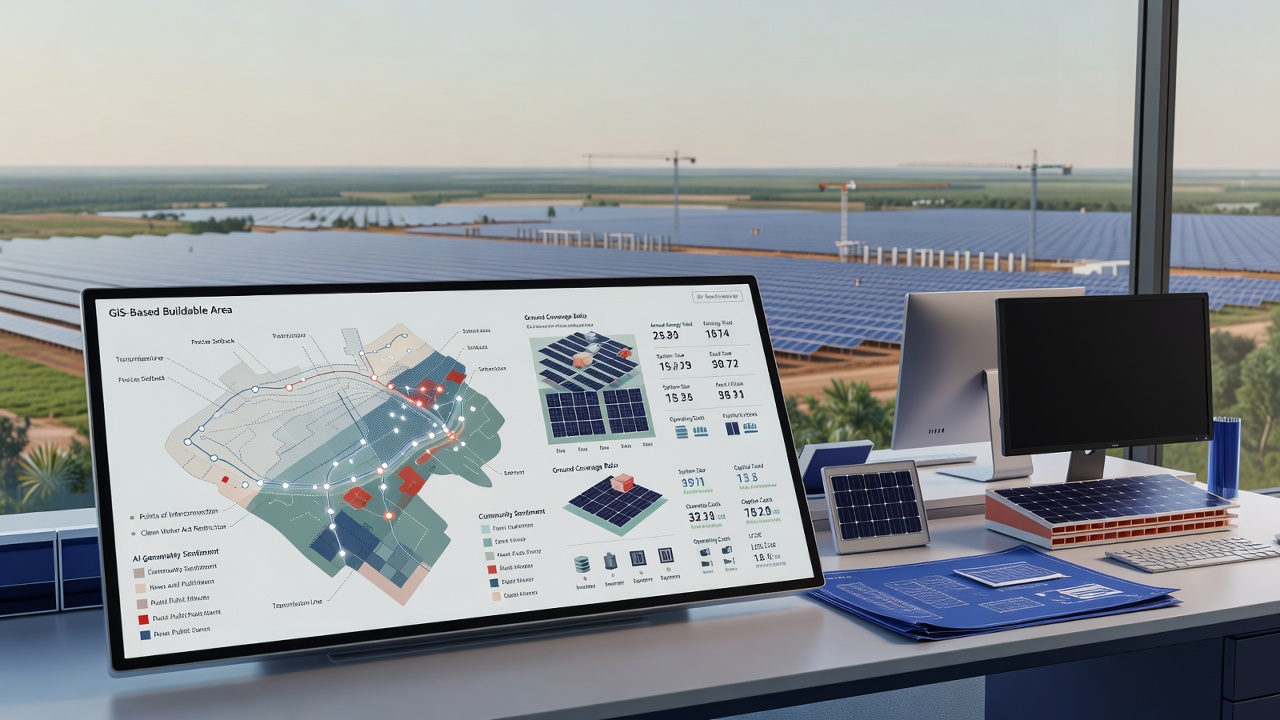
PVcase has introduced Concept, a cloud-based software tool designed to help utility-scale solar developers decide whether a prospective site is worth pursuing before committing significant engineering resources. The tool fills what the company calls the "missing middle" between initial site selection and detailed project engineering, giving development teams a structured way to reach a go or no-go decision.
Addressing a costly industry problem
According to PVcase, project attrition has become a persistent drain on developer resources. In a company survey on the state of project development, 46% of respondents said at least half their solar projects never reach construction. PVcase senior VP of engineering Karen Djoury said the issue often isn't a lack of available data but poor organization of it. "It's not that there's a lack of data but it's a lack of control of data," she said, adding that tracking assumptions consistently is what makes go/no-go calls difficult.
PVcase CEO David Trainavicius framed the new tool as a way to shorten that evaluation window. "Every site in a pipeline starts as a 'maybe,' and too many stay that way too long, pulling engineering time into projects that won't get built," he said, describing Concept as a "single source of truth" meant to move viable sites "from maybe to megawatts faster."
How the software works
Concept pulls in site data either from PVcase's own Prospect database or from imported KML, KMZ, or shapefiles. It then performs a buildable area analysis using GIS data, factoring in setbacks tied to site features and local regulations, nearby transmission lines and points of interconnection. The software also flags applicable government rules, such as Clean Water Act restrictions, and includes an AI-generated estimate of local community sentiment drawn from news coverage and public meeting minutes.
Users can accept the automated buildable-area results or manually override them - for instance, in areas where landowners are open to clearing trees or where a sloped section could be graded affordably. Once the buildable area is set, the software auto-generates a preliminary layout of module rows, inverters and other equipment based on a specified Ground Coverage Ratio, drawing from a component database with thousands of entries. Developers can adjust equipment choices and GCR to see real-time effects on system size, annual energy yield, capital and operating costs, and levelized cost of energy (LCOE).
From concept to construction-ready design
Each combination of layout and financial assumptions can be saved as a distinct scenario, letting teams compare options before engaging consultants or engineering staff. PVcase product manager JP Baertson said the goal is to surface potential obstacles - particularly policy-related ones - as early as possible, noting that one customer's project pipeline had tripled in size without a corresponding increase in projects reaching construction-ready status.
If a team decides to proceed, a chosen scenario can be exported as a DXF file compatible with PVcase Ground Mount or other CAD tools, allowing an engineering team to complete the final design. PVcase Concept is available worldwide as a standalone product or integrated with PVcase Prospect in the United States starting November 16, 2026. Company representatives are scheduled to discuss the tool at the RE+ 2026 trade show.